Writing a personal letter

A personal letter, also known as a cover letter or motivational letter, is a way to introduce yourself when applying for a job. It is sent along with your CV and gives you the opportunity to demonstrate why you are the right person for the job. Use our tips and templates to create your personal letter.

Free templates for personal letters

Many companies and organizations provide templates for personal letters. You can find several good suggestions by searching for "personal letter examples" or "personal letter template" on Google.

Arbetsförmedlingen offers three templates for personal letters that you can download and customize. Replace the text in the templates with your own information. Choose the template that best matches the format of your CV.

Download free templates for personal letter
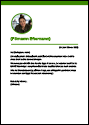
Personal letter template green with photo

Personal letter template, green with photo docx, 1 MB.

This template has a green header where you can insert a photo of yourself. We provide examples within the template to help you create a personal letter.
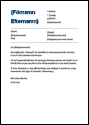
Personal letter template with blue colour

Personal letter template with blue colour docx, 77 kB.

This template has blue accents and does not include a photo. We give examples within the template to help you create a personal letter.
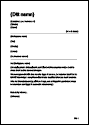
Simple personal letter template

Simple personal letter template docx, 25 kB.

This is a simple template without a photo. We provide examples within the template to help you create a personal letter.

Matching templates for CV

How to write a personal letter

A personal letter is a more detailed presentation of yourself that you send along with your CV when applying for a job. It is important to ensure that your CV and personal letter complement each other and do not repeat information. A good length for a personal letter is a maximum of one A4 page.

When writing a personal letter, it is important to highlight your personal qualities. You can find inspiration in our list of personal qualities.

Personal qualities A–Z

  1. Start with the most important information. Write a brief and compelling introduction, explaining the job you are applying for and why you are the right fit. This will immediately capture the reader’s attention.
  2. Customize your letter for the specific job you are applying to. Include exactly what the employer is looking for, so that your letter addresses their requirements.
  3. Express yourself professionally, but avoid being overly formal or using industry-specific jargon that may not be understood by everyone. Avoid getting too detailed.
  4. Provide examples that illustrate your personal qualities. Rather than listing your personal qualities, describing situations that demonstrate them will leave a lasting impression on the reader. You can draw examples from your work, studies, or leisure activities.
  5. Avoid using clichés. Instead of generic phrases like "I work well under pressure" or "I'm outgoing", be specific and provide examples of how you work and what kind of person you are.
  6. You can end your letter with a positive statement, such as: "I look forward to meeting you and having the opportunity to share more about myself."

Having trouble getting started? Use Chat GPT or another AI tool. Here's what you can do with the tools:

  • Ask AI to come up with a text suggestion if you need inspiration.
  • Ask AI if the text you have written is clear and easy to read and if it highlights your strengths in a good way.
  • Let AI check your word choice, spelling, and grammar if you are unsure about anything.

Remember to always read through the suggestions you receive and make the text your own. Employers often use a recruitment system with built-in AI support, and there is a risk that your text will be rejected if it is entirely AI-generated. It is also important that you always save your text in Word or as a PDF so that it can be read correctly.

Want to know more?

Here you will find more information that we hope will inspire you.

More on play

On play, you will find more films, podcasts and webinars that may be of interest and provide you with valuable information.

Learn more about CV, application and job interview (some videos are subtitled in English)